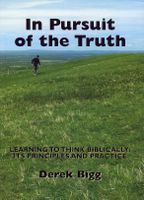
In Pursuit of the Truth

Learning to think biblically: its principles and practice. Introducing a book by Derek Bigg.

19 July 2007

Stewardship article

Stewardship Services is an organisation that has been established to assist Christian believers and the church as a whole in the matter of giving and financial administration. On their website, they say:
We see Stewardship as more than a service. It is a value - a lifestyle choice that recognises God's ownership of all that we have.

Our approach is twofold:

• Facilitating effective giving - serving over 20,000 donors, we distribute more than £30 million of giving into God's world every year.
• Promoting biblical principles and practice - of joyful giving, planned stewardship, and generosity.
Derek Bigg was invited by them to contribute an article for their website, "Christian Stewardship: A Biblical Perspective". The article explores some of the ideas covered in "In Pursuit of the Truth", relating to our use of money.
As we now consider what the way of grace means for us today, we must first of all accept that the New Testament contains no direct teaching on regular, long-term giving. We only have the apostle Paul’s instructions in his letters to Corinth regarding a special collection. As with so many practical issues, we must look for the basic principles underlying the specific teaching given in the 1st century. We then have to apply them to our own 21st century situation. In 2 Corinthians 8-9 we find five principles of major significance. Here they are:
• Adopt the right attitude.
• Let your heart be the arbiter.
• Give in proportion to blessing received.
• Aim for Christian equality.
• Follow the example of Christ.

Labels: ,

10 June 2006

Article by Derek Bigg

Affinity is an organisation committed to Bible-centred co-operation between churches. They are involved in various activities - more details can be found here - and publish several magazines. Their Theological Team publish both Foundations, a theological journal, and Table Talk, a concise briefing.

Derek Bigg, the author of In Pursuit of the Truth, has had an article entitled "Fulfilling the Law" published in these magazines. The material covered in these articles is developed in more detail in Part II, sections B and C of his book.

Labels: ,

17 March 2006

Contents

PREFACE: Let truth prevail

Part I First things first: A framework for thinking biblically

Part II By way of application: Some case studies

A. Divine guidance: An impossible dream?
B. The law: Obey it or fulfil it?
C. The Ten Commandments: God's law for today?
D. Work: Delight or drudgery?
E. Money: The answer for everything?

POSTSCRIPT: An open invitation

Scripture index

Labels:

15 March 2006

Book review

For some decades now, reformed evangelical churches in the UK have been moving in the direction of what is called "biblical" theology. It is accepted that the name is not satisfactory; it implies that other forms of theology aren't biblical. The distinction that is made between systematic and biblical theology is that whereas the former seeks to present "a thematic arrangement of biblical truth in the form of basic Christian doctrine", the latter "traces the historical development of God's purposes from Genesis to Revelation." (p.7) Theology is something that we understand as God reveals it, rather than as humans arrange it.

There is no shortage of excellent literature that traces out the structure of biblical theology - from Geerhardus Vos' "Biblical Theology" through Graham Goldsworthy's books right up to Tim Chester's recently published "From Creation to New Creation." The problem up to now is that there has been little to tell us how this theological approach ought to be applied - how we should live in the light of God's unfolding revelation.

"In Pursuit of the Truth" is the first book that I have come across which seeks to correct this omission. The first, and shorter, part of the book is used by Derek Bigg to explain the basics of biblical theology. Although the books mentioned above do the same, the "principles of interpretation" that Derek uses to talk about God's unfolding plan were new and helpful. However, the real focus of Derek's book is the second part. This consists of a series of case studies, taking the principles that have been set out, and applying them to issues that face Christians. The areas which are investigated are: guidance; the role of the law and more specifically the ten commandments; and Christian attitudes to work and money. In many cases, the author argues, despite our stated commitment to sola scriptura,our behaviour as Christians has been shaped not so much by God's Word as by our culture, our traditions, at times even by the songs that we sing! Books that we read are often not informed by a consistent biblical theology, he argues, and he is not afraid to challenge inconsistency from respected teachers, where that is appropriate. So the conclusions that are drawn in this study are at times surprising and biblically radical.

I was entirely happy with these conclusions - though it ought to be said that this theological approach has had a direct impact on my Christian life for some years, so I am likely to be a willing reader! My only reservation about the book is that the helpful illustrations of how biblical theology works take on a life of their own in the book. It is hard to remember at times that the illustrations are derived from the Bible, rather than being ideas that are being imposed on the Bible by the author. This is an important distinction; if the illustrations are man-made, then they are just another way of looking at the text. If the illustrations are genuine reflections of the nature of the Bible (as I believe they are), then they are in a sense the correct way to look at the text.

In a post-script, the author is happy to acknowledge the provisional nature of his conclusions, and invite further discussion. He is raising these issues out of a desire to see ongoing reformation within the church. A growing seriousness about the content of God's Word and its impact on our lives and the lives of our churches is something that we all ought to be looking for. If the author's approach to interpreting the Bible is correct, then this book ought to have a major impact even within evangelical churches committed to the idea of ongoing reform, let alone in less Bible-based congregations. Whether this is so or not, the author's hope - and mine also, having read his book! - is that this book should be a starting point for further serious discussion about the impact of the Bible in the life of Christians.

The author has applied biblical theology to a limited number of areas of Christian life. It is natural to ask what would happen when the same principles are applied to other areas - the nature of the church; the nature of mission; baptism; church leadership; music. All sorts of areas of Christian life have the potential for reformation on the basis of a consistent understanding of God's communication with his people. I look forward to other books with the same theological foundation.

Review from "Beginning With Moses", previously published in "Evangelicals Now".

Labels:

The Blurb

Why do Christians often receive conflicting advice when wrestling with important decisions?

Why is there so much disagreement among Christans over the Sabbath and Sunday?

Why do some Christians feel obliged to tithe while others see tithing as an inappropriate approach to stewardship?

The commonest and most significant reason for such differences is the absence of a proper biblical framework for our thinking.

This book sets out six principles of interpretation, derived from the Bible itself, which together provide the kind of framework we need. The principles are fully explained, with illustrations, and then brought to bear on several key issues: divine guidance, the law, the Ten Commandments, work and money. Each chapter also includes incisive practical application relevant to the Christian life today.

Labels:

The Author

Derek Bigg lives in mid-Sussex and is married with three grown-up children. He has divided his working life between the City and Christian ministry. After graduating from the London Bible College (now London School of Theology) he spent some years in Spain as a Bible teacher. He is a member of Haywards Heath Evangelical Free Church, where his chief responsibility in retirement is the training of younger men and women.

Labels: